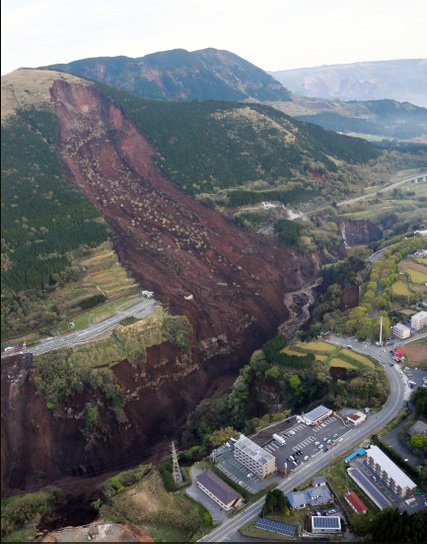
Japan drone footage showing landslides and seismic faults after powerful quakes --
Drone footage showing the impact of a large landslide and deep cracks around seismic fault lines after powerful earthquakes hit Kyushu Island in Japan.
"They should prepare disaster countermeasures, led by local governments.”
Nobuo Fukuwa, director of Nagoya University’s Disaster Mitigation Research Center, said: “Areas that have not been hit by quakes recently should change their mind-set and [assume] that the time for a quake is approaching. They should prepare disaster countermeasures, led by local governments.”
Linked series of quakes could strike anywhere
An earthquake may occur in the future in a fault zone that has not even been found yet.
A new fault zone was found when the Iwate-Miyagi Inland Earthquake hit the Tohoku region in 2008. It had a magnitude of 7.2 and registered upper 6 on the Japanese seismic intensity scale of 7.
Earthquakes frequently occur in Japan because the country is located on four plates — out of a dozen or so that cover the surface of the Earth — that overlap each other.
Also, a sea plate is submerging beneath a land plate, causing tension to build up.
This is a major factor that causes active faults to move.
TOKYO, Japan - Even as rescue operations intensified in earthquake-stricken southern region of Japan, a mysterious foam flowed around a city, merely 90 kms away from the epicentre of the quake.
The foam that covered the streets of the Fukuoka city, that is about two-hours away from Kumamoto, is said to be directly linked to the earthquake. Several reports speculated that the foam could be the by-product of an underground pipe which burst as a result of the seismic activity, but there was no official confirmation on the issue.
Enormous Landslides
Meanwhile, both the earthquakes triggered enormous landslides that swept away not only the houses and roads, but also railway lines and brought buildings crumbling down.
Published on Apr 17, 2016
April 2016 The BBC's Robin Brant reports from quake-hit Minamiaso in Japan where a bridge has collapsed and landslides have caused devastation.
90,000 Evacuated
According to the disaster management office, about 41 (updated-latest is 272) people are known to have died and over 1,037 people have been injured in both the earthquakes. Reports further added that over 90,000 people have been evacuated so far and at least 500 people are believed to be trapped in one settlement that witnessed several landslides.
Reports added that aerial footage showed a bridge on a main trunk road had crashed on to the carriageway below, its pillars felled by the huge seismic jolt. Tens of thousands of people were moved to temporary accommodation, and several others huddled in makeshift shelters even as rescuers continued their search for those who might be trapped under the debris of the two powerful quakes.
The government has said that there were “multiple locations where people have been buried alive,” and reports suggested scores were missing.
The country’s Prime Minister Shinzo Abe said in a news statement, “Around 25,000 troops, firefighters, medics and other rescue personnel were to be joined by members of the U.S. military.”
Abe added, “Our Defence Minister informed me that the U.S. military said aerial transportation is available. We are grateful for the offer.”
Reports revealed that the U.S. has almost 50,000 service people stationed in Japan.
Commenting on those trapped, Abe said, “Nothing is more important than human life and it’s a race against time. Daytime today is the big test. I want rescue activities to continue with the utmost effort.”
About 400 aftershocks were felt in the Kumamoto region and in other parts of central Kyushu. Authorities persisted with their warning that the quake-loosened hillsides could be at risk of collapse as aftershocks continued in the Kumamoto region that witnessed rainfall.
After the quakes, more than 400,000 houses have been left without water and 200,000 homes suffer power cut.
Rescuers scramble to find survivors in rubble of collapsed buildings
One person reported dead, many buildings damaged
An expert predicts this quake "will do a lot of a damage," notes aftershocks are likely
Tsunami advisory issued
The U.S. Geological Survey reported that the latest quake struck just west-southwest of Kumamoto-shi and about 8 miles south-southeast of Ueki, the epicenter of the late Thursday tremor that left nine dead.
"No question, this is a large and very important earthquake," said Doug Given, a geophysicist with the USGS. "And it will do a lot of damage."
The quake prompted the Japan Meteorological Agency to issue a tsunami advisory for coastal regions of Japan on the Ariake Sea and Yatsushiro Sea around 2 a.m. Saturday (1 p.m. ET Friday). Tsunami advisories are issued when the tsunami height is expected to be between 0.2 and 1 meter (0.65 to 3.3 feet). A warning would be for larger tsunamis.
The agency subsequently lifted all tsunami warnings and advisories.
As Given noted, "the four islands of Japan are on the edge of what's traditionally been known as the 'Ring of Fire'" -- a stretch along parts of the Pacific Ocean prone to volcanoes and earthquakes.
GETTY IMAGES
The rescue workers take care of an elderly woman suffering from the shock after the 7.3 magnitude earthquake
Victor Sardina, a geophysicist in Honolulu, Hawaii, told CNN that the latest quake was about 30 times more powerful than Thursday's deadly tremor. He predicted "severe, serious implications in terms of damage and human losses."
The shallow depth of the quake -- about 10 kilometers, or 6 miles -- and the densely populated area where it struck could prove to be devastating, according to experts.
Two large earthquakes have struck Japan over the past 2 days. Major damage has occurred, multiple people killed, and thousands injured according to main stream media reports.
An earthquake shook buildings and halted train lines in Tokyo Monday, days after Japan' signed off on the basic safety of a third reactor.
The United States Geological Survey measured the quake at magnitude 5.3.
An earthquake with a preliminary magnitude of 5.6 has shakenTokyo and surrounding areas but no tsunami warning has been issued, the Japan Meteorological Agency said. Neither was found to have been affected.
Locals were alerted to the impending quake with a mobile phone alert.
The agency said the epicenter of the quake was located in northern Saitama Prefecture, which is north of Tokyo.
There were no immediate reports on damage and injuries.
-
Japan is one of the most earthquake-prone nations in the world.
Rigid building codes and strict enforcement mean that even powerful quakes frequently do little damage to infrastructure.
6.3 Earthquake Off Japan Coast as Typhoon Vongfong Roars In
An earthquake with an estimated 6.3 magnitude has shaken the seabed 150km south of the Japanese coast, at a depth of 13km according to the Japan Meteorological Agency.
The quake comes as the world’s biggest super-typhoon this year, Vongfong, is striking the south of the country. Have you noticed that here in the U.S. we're not hearing about the double threat to Fukushima ?
M 6.3 EARTHQUAKE - HOKKAIDO, JAPAN REGION - Oct 11, 2014
I like this clip;s site well put on net.Our news over here show you 3>4 min news on things .6 billion ppl and 4 min news ? If you want to know the truth ,you have to look yourself .Thank you +THEQuest2112+Staceylane74+kevin blanch & others ,,, for keeping the bastards honest ,and informing us on many things .Keep it up * GOOD JOB my dear friends. " Mother Earth is not happy ,with what the Capital *PIGS are doing to her :+( p
No tsunami warning has been given and no damage was reported as a result of the quake, which is believed to have been too weak, deep and far from shore to be a danger.
However, Japan is bracing itself for the arrival of this year's largest super-typhoon, Vongfong, which it is predicted may cause 15m waves when it reaches Okinawa island chain later today or early Sunday morning. Wind speeds are currently 261kph, although Vongfong is believed to be losing some of its power.
6.3 quake off northern Japanese coast as Typhoon Vongfong hits Okinawa
Published time: October 11, 2014 06:25 Edited time: October 12, 2014 03:04
A 6.3 earthquake has been registered early Saturday off Japan’s northern coast by the US Geological Survey. The quake comes as the world’s biggest super-typhoon this year, Vongfong, is striking the south of the country.
The tremor occurred at 02:36 GMT, the Japan Meteorological Agency reported. There have been no reports of damage, casualties or a tsunami alert.
The epicenter of the quake was located 154 kilometers away from the southeastern city of Hachinohe, in Japan’s southeast Aomori Prefecture, at a depth of 13 kilometers.
"There is no question that (Vongfong) is an extremely large, extremely powerful typhoon," an official from Japan's Meteorological Agency told Reuters. "It's the strongest storm we've had this year, definitely, although it has lost some strength from its peak."
Reid Wiseman, an astronaut aboard the International Space Station, tweeted a photograph of Vongfong, from space, saying: "I've seen many from here, but none like this."
TOKYO - Japan was bracing on Friday for its strongest storm this year, a super typhoon powering north towards the Okinawa island chain that threatens to rake a wide swathe of the nation with strong winds and torrential rain. Typhoon Vongfong, which at one point rivalled last year's devastating Haiyan in strength, was weakening slightly as it moved across the open ocean, but still packed winds gusting as high as 259 kph (160 mph) . "There is no question that it is an extremely large, extremely powerful typhoon," said an official at Japan's Meteorological Agency (JMA). "It's the strongest storm we've had this year, definitely, although it has lost some strength from its peak." The storm, which will be Japan's second typhoon in a week, was south of Okinawa, and moving north at 15 kph (9 mph) with sustained winds of 185 kph (114 mph) as of Friday afternoon, the agency said. The typhoon is moving extremely slowly, which raises the danger of landslides and flooding. It was likely to be closest to Okinawa, an island chain 1,600 km (1,000 miles) southwest of Tokyo, and the home of the largest contingent of U.S. troops in Japan, late on Saturday or early on Sunday. Television broadcast images of residents of Minami Daitojima, an island southeast of Okinawa, boarding up windows ahead of the storm. Government officials were set to meet on Friday night to coordinate their response, Chief Cabinet Secretary Yoshihide Suga told a regular news conference . "We are calling on all citizens to pay close attention to weather reports and respond promptly if the authorities advise them to evacuate," Suga said. The typhoon was expected to weaken as it moved north, however, and likely to hit land on Sunday on the westernmost main island of Kyushu, before moving northeast towards Japan's largest main island of Honshu, where it is likely to weaken into a tropical storm. Tokyo was set for heavy rain, at the worst.
10/10/2014 -- Awesome view of Super Typhoon "VONGFONG" seen from space 台風 (1080p HD)
Tropical Storm Risk, which tracks typhoons, labelled Vongfong as a Category 4 typhoon, set to weaken to Category 2 before hitting Kyushu. There are no nuclear plants on Okinawa, but there are two on Kyushu and one on Shikoku island, which borders Kyushu and may be hit. All are currently halted in line with national policy. The Fukushima Daiichi nuclear plant, crippled by an earthquake and tsunami in 2011, is on the other side of the country, which is likely to see rain at the worst. Vongfong, which means "wasp" in Cantonese, was following the path of Phanfone, a typhoon that slammed the mainland on Monday, disrupting transport and prompting evacuation advisories for hundreds of thousands of people. Seven people were killed, including three U.S. airmen swept out to sea and a man who died while surfing. Refiner Nansei Sekiyu KK, which is wholly owned by Brazil's Petrobras, suspended marine berth operations at its 100,000 barrels-per-day Nishihara refinery in Okinawa on Thursday but crude refining operations were unaffected. More than 1,000 rescue workers stepped up a search for the last eight missing victims of the Mount Ontake volcanic eruption, hoping to make progress before the storm hits. It was unusual for two powerful typhoons to hit Japan in such quick succession, the JMA official said, but added the overall number of such storms had not increased. "It's more coincidence than anything else, mainly due to the way the high pressure systems are located off Japan this year." Two to four typhoons make landfall in Japan each year.(Additional reporting by James Topham; Editing by Clarence Fernandez)
NATURAL DISASTERS
Is Fukushima capable of withstanding a super typhoon?
The strongest typhoon of the year is expected to hit Japan this weekend. Of particular concern is the crippled Fukushima nuclear plant.
The massive storm named Vongfong is expected to be near South Korea and Japan some time over the weekend, just days after the Japanese archipelago was struck by another typhoon which claimed the lives of at least six people. The Japan Meteorological Agency was quoted as saying that Vongfong's strength was "very much similar" to that of Haiyan, which ravaged the Philippines last November, leaving nearly 8,000 people dead or missing when gusts of around 300 kilometers (190 miles) per hour tore through the country.
Alongside strong winds and heavy rain capable of causing landslides and flash floods, such super storms can also trigger an abnormal rise of water called a storm surge which is often the greatest threat to life and property. Of particular concern in Japan is the area around the crippled Fukushima Daiichi nuclear power plant which is still recovering from the 2011 quake and tsunami disaster that triggered a meltdown at the plant.
The operator of the battered power plant, TEPCO, has been having trouble with the early stages of an ice wall being built under the broken reactors to prevent radioactive water from leaking into the ocean. But is the plant also braced for the impact of a super typhoon?
Global Rumblings depends heavily
upon the the support that you provide
by clicking on and purchasing products
that are advertised here. Without your
support, this site could not sustain
itself because it takes time and money
to stay on the internet. Thank You!