My Zimbio
Top Stories
Showing posts with label geological history. Show all posts

Wednesday, May 25, 2011

Egyptian pyramids found by infra-red satellite images


By Frances Cronin


Modern day San El Hakkar and infrared image of ancient TanisThe infrared image on the right reveals the ancient city streets of Tanis near modern-day San El Hagar

Related Stories

Seventeen lost pyramids are among the buildings identified in a new satellite survey of Egypt.
More than 1,000 tombs and 3,000 ancient settlements were also revealed by looking at infra-red images which show up underground buildings.
Initial excavations have already confirmed some of the findings, including two suspected pyramids.
The work has been pioneered at the University of Alabama at Birmingham by US Egyptologist Dr Sarah Parcak.
satellite image of pyramidAn infra-red satellite image shows a buried pyramid, located in the centre of the highlight box.
She says she was amazed at how much she and her team has found.
"We were very intensely doing this research for over a year. I could see the data as it was emerging, but for me the "Aha!" moment was when I could step back and look at everything that we'd found and I couldn't believe we could locate so many sites all over Egypt.
"To excavate a pyramid is the dream of every archaeologist," she said.
The team analysed images from satellites orbiting 700km above the earth, equipped with cameras so powerful they can pin-point objects less than 1m in diameter on the earth's surface.
Infra-red imaging was used to highlight different materials under the surface.
Test excavations
Ancient Egyptians built their houses and structures out of mud brick, which is much denser than the soil that surrounds it, so the shapes of houses, temples and tombs can be seen.
"It just shows us how easy it is to underestimate both the size and scale of past human settlements," says Dr Parcak.
And she believes there are more antiquities to be discovered:
"These are just the sites [close to] the surface. There are many thousands of additional sites that the Nile has covered over with silt. This is just the beginning of this kind of work."
BBC cameras followed Dr Parcak on her "nervous" journey when she travelled to Egypt to see if excavations could back up what her technology could see under the surface.
In the BBC documentary Egypt's Lost Cities, they visit an area of Saqqara (Sakkara) where the authorities were not initially interested in her findings.
But after being told by Dr Parcak that she had seen two potential pyramids, they made test excavations, and they now believe it is one of the most important archaeological sites in Egypt.
An infra-red satellite image reveals the city of Tanis
But Dr Parcak said the most exciting moment was visiting the excavations at Tanis.
"They'd excavated a 3,000-year-old house that the satellite imagery had shown and the outline of the structure matched the satellite imagery almost perfectly. That was real validation of the technology."
The Egyptian authorities plan to use the technology to help - among other things - protect the country's antiquities in the future.
During the recent revolution, looters accessed some well-known archaeological sites.

Start Quote

Dr Sarah Parcak
Indiana Jones is old school, we've moved on from Indy, sorry Harrison Ford ”
Dr Sarah ParcakSpace Archaeologist
"We can tell from the imagery a tomb was looted from a particular period of time and we can alert Interpol to watch out for antiquities from that time that may be offered for sale."
She also hopes the new technology will help engage young people in science and will be a major help for archaeologists around the world.
"It allows us to be more focused and selective in the work we do. Faced with a massive site, you don't know where to start.
"It's an important tool to focus where we're excavating. It gives us a much bigger perspective on archaeological sites. We have to think bigger and that's what the satellites allow us to do."
"Indiana Jones is old school, we've moved on from Indy, sorry Harrison Ford."
Egypt's Lost Cities is on BBC One on Monday 30 May at 2030 BST.

More on This Story

Related Stories

The BBC is not responsible for the content of external Internet sites

Ancient Egypt (DK Eyewitness Books)


Tuesday, March 22, 2011

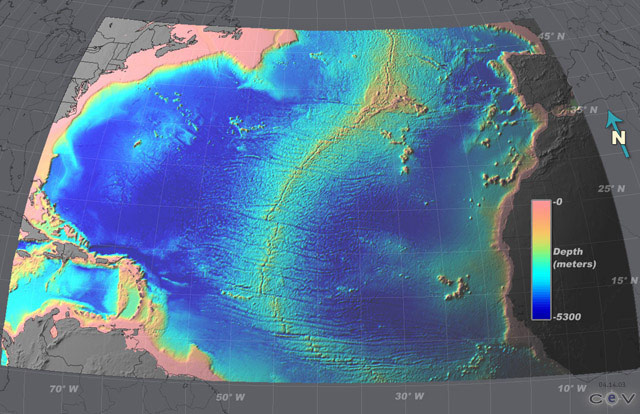
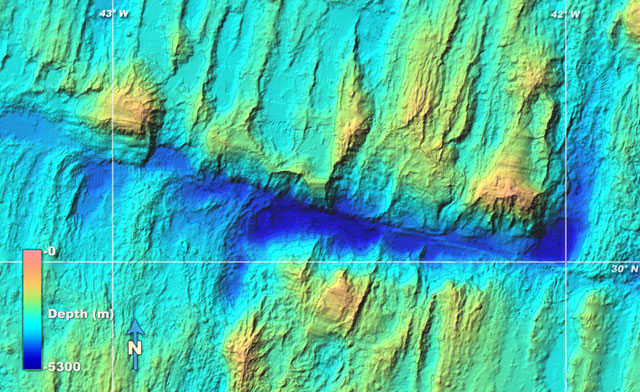
The Mid-Atlantic Ridge Spreading

Lost City Expedition: Science
The Mid-Atlantic Ridge and its Spreading


The Mid-Atlantic Ridge is the branch of the mid-ocean ridge that runs up the middle of the floor of the Atlantic Ocean. This ocean was not always so wide. About 150 Million years ago (150, 000,000 years!) North America, Europe, and Africa fit snuggly together. On a map you can see how the shapes of their coastlines fit. At about that time, the three giant blocks of the Earth split apart as a rift developed between them. As the rift widened and seafloor spreading began, the continents moved slowly apart. Seafloor spreading is a very slow process, not much faster than the rate that fingernails or hair grows, but over millions of years this adds up. 


Today, the continents are about 3000 miles apart and seafloor spreading has kept up with their growing separation to make the rocks beneath the Atlantic Ocean. 


Seafloor spreading is one of the most important processes on our planet. At the rift in the middle of mid-ocean ridges, volcanoes, circulating hot water, and very peculiar animals all come together. Each of these contributes in its own way to what are referred to as “hydrothermal systems”.


The volcanic activity happens because of the way the rift opens. As it widens, hot material of the Earth’s, mantle which is made up of bright green rocks call peridotites, rises to fill the gap. As it rises, it begins to melt by just a little, a few percent. The easiest-melting droplets of material mix together and form streams of liquid that move upward toward the surface faster than the mantle material it came from. The hot molten material (about 1400° C or 2500°F) rises because it is much less dense than its surrounding material, just as a balloon with hot air or helium rises through the atmosphere. As it approaches the surface it can form large pools called magma chambers where crystals grow in it as it cools. As cracks form in the seafloor above, the magma leaks out to the surface as lava-the same material as what comes out of volcanoes in Iceland or Hawaii. The cold seawater on the bottom of the ocean chills the lava very quickly and it forms lumpy masses called pillow basalts (basalts are a very common type of black volcanic rock). These are found all along the mid-ocean ridges. 

Contributing source: http://www.lostcity.washington.edu/science/geology/midatlanticridge.html

Anti-Aging: Turn the Clock Back!

Search & Win

Sunday, February 27, 2011

Magnetic Pole Shift Gaining Momentum

From http://www.abovetopsecret.com/forum/thread667331/pg1


Anti-Aging: Turn the Clock Back!

Search & Win

Just found this story on Fox news of all places! Looks like the Magnetic Pole Shift is gaining momentum -

The Earth's 
magnetic field is changing at an increasing rate, throwing off airports and altering the aurora borealis -- and its effect on ordinary compasses could mean the difference between homeward bound and hopelessly lost

Earth’s northernmost magnetic point -- or magnetic north -- is distinct from its geographic North Pole, and scientists have long known that the magnetic poles are on the move

But the magnetic poles have been moving faster lately, sliding towards Siberia at 34 miles per year at a speed that's accelerated 36 percent over the last 10 years, according to the United States Geological Survey, or USGS

Depending on location and journey length, unaware hikers or boaters could find themselves hundreds of miles off course if they don’t calibrate for the shift, experts said

The magnetic shift is costing the aviation and marine industries millions of dollars to upgrade navigational systems and charts, Floridas Sun Sentinelreported.

The polar shift is directly related to the movement of Earth’s magnetic field, which in turn, is related to the movement of Earth’s liquid iron core. The core is in a constant state of convection, or the transfer of heat within fluids. Since the core is convecting, it produces what Love referred to as a “naturally occurring electrical conductor.” And with electric current comes the magnetic field.

Fluctuations in the magnetic field have occurred for hundreds of thousands of years, so the shifting pole doesn’t exactly worry scientists. Sometimes the movement is slow, sometimes fast. The rapidity of the change has to do with the amount of activity going on in the earth’s core. But over time, the axel pole and the magnetic pole eventually equal one another

Add to the ever evolving nature of Earth’s magnetism the fact that the overall magnetic field has been decreasing as well. Scientists have only been able to measure the intensity of the field since the 1830s, but ever since then, its strength has been on the decline, having decreased by about 10% since it was first measured. But for those concerned with this polar shift -- or even a possible polar reversal -- Love says there is no need to worry in our lifetime 


Looks like no need to worry in our lifetime, but none the less, a very concerning and interesting story. What will the future hold with a decreasing Magnetic field? What implications would this have on a technology dependant society that frequently encounters Solar flares, CME's etc. 

What would be the implications of changing poles? 

Could this process speed up faster than scientists actually know of? 

www.foxnews.com... 

www.kvue.com.

Wednesday, January 19, 2011

Researchers aim to resurrect mammoth in five years

Researchers aim to resurrect mammoth in five yearsMNHN Bibliotheque Centrale – Artist's impression of the prehistoric mammoth. Japanese researchers will launch a project this year …
TOKYO (AFP) – Japanese researchers will launch a project this year to resurrect the long-extinct mammoth by using cloning technology to bring the ancient pachyderm back to life in around five years time.
The researchers will try to revive the species by obtaining tissue this summer from the carcass of a mammoth preserved in a Russian research laboratory, the Yomiuri Shimbun reported.
"Preparations to realise this goal have been made," Akira Iritani, leader of the team and a professor emeritus of Kyoto University, told the mass-circulation daily.
Under the plan, the nuclei of mammoth cells will be inserted into an elephant's egg cell from which the nuclei have been removed, to create an embryo containing mammoth genes, the report said.
The embryo will then be inserted into an elephant's uterus in the hope that the animal will eventually give birth to a baby mammoth.
  The elephant is the closest modern relative of the mammoth, a huge woolly mammal believed to have died out with the last Ice Age.
Some mammoth remains still retain usable tissue samples, making it possible to recover cells for cloning, unlike dinosaurs, which disappeared around 65 million years ago and whose remains exist only as fossils
 Researchers hope to achieve their aim within five to six years, the Yomiuri said.
  The team, which has invited a Russian mammoth researcher and two US elephant experts to join the project, has established a technique to extract DNA from frozen cells, previously an obstacle to cloning attempts because of the damage cells sustained in the freezing process.
Another Japanese researcher, Teruhiko Wakayama of the Riken Centre for Developmental Biology, succeeded in 2008 in cloning a mouse from the cells of another that had been kept in temperatures similar to frozen ground for 16 years.
The scientists extracted a cell nucleus from an organ of a dead mouse and planted it into the egg of another mouse which was alive, leading to the birth of the cloned mouse.
Based on Wakayama's techniques, Iritani's team devised a method to extract the nuclei of mammoth eggs without damaging them.
But a successful cloning will also pose challenges for the team, Iritani warned.
"If a cloned embryo can be created, we need to discuss, before transplanting it into the womb, how to breed (the mammoth) and whether to display it to the public," Iritani said.
"After the mammoth is born, we will examine its ecology and genes to study why the species became extinct and other factors."
More than 80 percent of all mammoth finds have been dug up in the permafrost of the vast Sakha Republic in eastern Siberia.
Exactly why a majority of the huge creatures that once strode in large herds across Eurasia and North America died out towards the end of the last Ice Age has generated fiery debate.

  Paperbacks   On the Extinction of the Mammoth.  -

                        The extinction of the mammoth: By Charles genenthal

                        Pleistocene extinctions: Homo habilis, Diprotodon, Mammoth, Megatherium, Smilodon, Smilodon populator, Machairodus, Homotherium, Dinofelis

                        On the extinction of the mammoth 

                         Twilight of the Mammoths :: Ice Age Extinctions &_the Rewilding of America

                         Mammoth mystery: did climate change wipe out North America's giant mammals, or did our stone age ancestors hunt them to extinction?: An article from: OnEarth


Some experts hold that mammoths were hunted to extinction by the species that was to become the planet's dominant predator -- humans.
Others argue that climate change was more to blame, leaving a species adapted for frozen climes ill-equipped to cope with a warming world.
Search & Win


Anti-Aging: Turn the Clock Back!

10 Day Weight Loss Pills

Popular Posts

URGENT - Your LIBERTY at RISK


GET A GROUPON!


Curious about what the future holds? Click here to find out how you can receive a 10 minute psychic reading from Psychic Source.

Calculator-1.com - The Best Free Online Calculatorн

Fine Art - Painting Lessons: Real Art!
What is Bio-Farming? Can anyone do it?
Related Posts Plugin for WordPress, Blogger...

CURRENT MOON
My Zimbio
Top Stories
 
My Zimbio
Top Stories Get 100 FREE Visitors to Your Website!
eXTReMe Tracker
AyurCat for Cat Health Care