Based on geological definitions of a continent, the Earth actually has a lost eighth continent, known as Zealandia. Most of this continent is submerged beneath the sea, while a tiny sliver, including New Zealand, is above the water.
Credit: GSA Today 2017
Earth has eight continents, and world maps should reflect this, geologists say.
The eighth, a lost continent called Zealandia, isn't a huge landmass that geographers have somehow missed. Rather, only small bits — including New Zealand, New Caledonia and a few other specks of land in the vast Pacific Ocean — are above sea level. The rest of this continent lies beneath the waves, a new study suggests.
"I hope Zealandia will now start to appear on world maps which show the other continents," said Nick Mortimer, a geologist with GNS Science in Dunedin, New Zealand. "There is an extra one, and it is as real as all the others." [Photos: The World's Weirdest Geological Formations]
Topography of Zealandia. The linear ridges running north-northeast and southwest away from New Zealand are not considered part of the continental fragment, nor are Australia (upper left), Fiji or Vanuatu (top centre).[1]
Zealandia (pronunciation: /ziːˈlændiə/), also known as the New Zealand continent or Tasmantis,[2] is a nearly submerged mass of continental crust that sank after breaking away from Australia 60–85 Ma (million years) ago, having separated from Antarctica between 85 and 130 Ma ago.[3] It has variously been described as a continental fragment, a microcontinent and a continent.[4] The name and concept for Zealandia were proposed by Bruce Luyendyk in 1995.[5]
The land mass may have been completely submerged about 23 Ma ago,[6][7] and most of it (93%) remains submerged beneath the Pacific Ocean.[8] How strongly Bollons Seamount (south of the Chatham Islands) remains connected to Zealandia is unknown. With a total area of approximately 4,920,000 km2 it is the world's largest current microcontinent, more than twice the size of the next-largest microcontinent and more than half the size of the Australian continent. As such, and due to other geological considerations, such as crustal thickness and density, it is arguably a continent in its own right.[9] This was the argument which made news in 2017, when geologists from New Zealand, New Caledonia and Australia concluded that Zealandia fulfills all the necessary requirements to be considered a continent, rather than a microcontinent or continental fragment.[4]
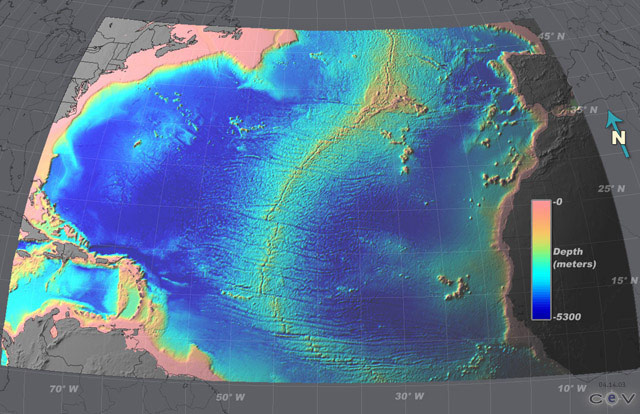
The Mid-Atlantic Ridge is the branch of the mid-ocean ridge that runs up the middle of the floor of the Atlantic Ocean. This ocean was not always so wide. About 150 Million years ago (150, 000,000 years!) North America, Europe, and Africa fit snuggly together. On a map you can see how the shapes of their coastlines fit. At about that time, the three giant blocks of the Earth split apart as a rift developed between them. As the rift widened and seafloor spreading began, the continents moved slowly apart. Seafloor spreading is a very slow process, not much faster than the rate that fingernails or hair grows, but over millions of years this adds up.
Today, the continents are about 3000 miles apart and seafloor spreading has kept up with their growing separation to make the rocks beneath the Atlantic Ocean.
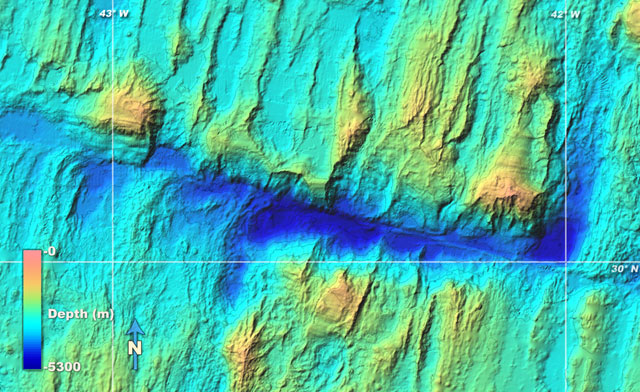
Seafloor spreading is one of the most important processes on our planet. At the rift in the middle of mid-ocean ridges, volcanoes, circulating hot water, and very peculiar animals all come together. Each of these contributes in its own way to what are referred to as “hydrothermal systems”.
The volcanic activity happens because of the way the rift opens. As it widens, hot material of the Earth’s, mantle which is made up of bright green rocks call peridotites, rises to fill the gap. As it rises, it begins to melt by just a little, a few percent. The easiest-melting droplets of material mix together and form streams of liquid that move upward toward the surface faster than the mantle material it came from. The hot molten material (about 1400° C or 2500°F) rises because it is much less dense than its surrounding material, just as a balloon with hot air or helium rises through the atmosphere. As it approaches the surface it can form large pools called magma chambers where crystals grow in it as it cools. As cracks form in the seafloor above, the magma leaks out to the surface as lava-the same material as what comes out of volcanoes in Iceland or Hawaii. The cold seawater on the bottom of the ocean chills the lava very quickly and it forms lumpy masses called pillow basalts (basalts are a very common type of black volcanic rock). These are found all along the mid-ocean ridges.
I have to admit I was thoroughly underwhelmed when geologist Ian Madin sent us to Haines Road near Canby. He said he’d found a previously undetected volcano. A perfect cone sat in a farmer’s field. When we got there, all we found was rolling “hills” in a Christmas tree farm. Just not impressive.
Hidden Volcano near Canby
But Ian’s photo showed something far more intriguing. He’s the Chief Scientist atOregon’s Department of Geology and Mineral Industries and he’s spending a lot of time with the most sophisticated imaging available. LIDAR uses lasers to map the land in stunning detail.
Using LIDAR, geologists can digitally remove every tree, bush and building to see the exact shape of the land underneath. A regular aerial photo shows just a farm field. LIDAR reveals a hidden volcano.
Pits of Mystery near Corvallis. LIDAR Courtesy DOGAMI.
Every more peculiar, Madin has spotted dozens of strange circles. Not crop circles. These are soil circles. The jury is still out what’s leaving these large circular depressions throughout the Willamette Valley. (But they’re never found in Washington County in the Tualatin basin. Odd.)
Just as before, we showed up in person and found a field with hollows that surely fill with water in the rainy season. They’re nothing to write home about until you realize there are nearly two dozen on this one farm and they’re all circular. Watch our story on Oregon Field Guide, Thursday, Feb. 10.
The fissures began appearing years ago. But in recent months, seismic activity has accelerated in northeastern Africa as the continent breaks apart in slow motion. Researchers say that lava in the region is consistent with magma normally seen on the sea floor -- and that water will ultimately cover the desert.
Cynthia Ebinger, a geologist from the University of Rochester in New York, could hardly believe what the caller from the deserts of Ethiopia was saying. It was an employee at a mineralogy company -- and he reported that the famous Erta Ale volcano in northeastern Ethiopia was erupting. Ebinger, who has studied the volcano for years, was taken aback. The volcano's crater had always been filled with a bubbling soup of silver-black lava, but it had been decades since its last eruption.
The call came last November. And Ebinger immediately flew to Ethiopia with some fellow researchers. "The volcano was bubbling over; flaming-red lava was shooting up into the sky," Ebinger told SPIEGEL ONLINE.
The earth is in upheaval in northeastern Africa, and the region is changing quickly. The desert floor is quaking and splitting open, volcanoes are boiling over, and seawaters are encroaching upon the land. Africa, researchers are certain, is splitting apart at a rate rarely seen in geology.
The first fracture appeared millions of years ago, resulting in the Red Sea and the Gulf of Aden. The second fracture, stretching south from Ethiopia to Mozambique, is known as the Great Rift Valley, and it is lined with several volcanoes. Millions of years from now, it too will be filled with seawater.
Could Go Quickly
But in the Danakil Depression, in the northern part of the valley, the ocean could arrive much sooner. There, low, 25 meter (82 foot) hills are the only thing holding back the waters of the Red Sea. The land behind them has already dropped dozens of meters from previous levels and white salt deposits on the desert floor testify to past encroachments of the sea. But lava soon choked off its access.
For now, no one can really say when the sea will finally flood the desert. But when it does, it could go quickly. "The hills could sink in a matter of days," Tim Wright, a fellow at the University of Leeds' School of Earth and Environment, said at a recent conference hosted by the American Geophysical Union (AGU) in San Francisco.
In the last five years, the geologic transformation of northeastern Africa has "accelerated dramatically," says Wright. Indeed, the process is going much faster than many had anticipated. In recent years, geologists had measured just a few millimeters of movement each year. "But now the earth is opening up by the meter," says Loraine Field, a scholar at the University of Bristol who also attended the conference.
HE AFAR TRIANGLE
The Great Rift Valley (northern part)
Earth tremors cause deep fissures to form in the desert floor and the ground in East Africa is shattering like broken glass. Researchers in the Gulf of Tadjoura, which juts into Djibouti from the Gulf of Aden, have recently registered a barrage of seismic shocks. "The quakes are happening on the mid-ocean ridge," Ebinger reports.
Shifting Tectonic Plates
Lava gushes out of fissures in these underwater mountain ranges to constantly create new earth crust -- when it hardens, it becomes part of the sea floor. As the magma surges upward, it spreads the ocean floor on both sides, shifting tectonic plates and causing tremors.
In recent months, the quaking in the Gulf of Tadjoura has been getting closer and closer to the coastline. As Ebinger explains, the splitting of the ocean floor will gradually extend to dry land. This is already the case along some fault lines in the Ethiopian desert, creating a geological spectacle that can otherwise only be witnessed deep below the surface of the ocean.
Even the pattern of earthquakes supports the conclusion that the desert landscape is transforming into a deep seafloor, according to a recent article in theJournal of Geophysical Research published by Zhaohui Yang and Wang-Ping Chen, two geologists at the University of Illinois at Urbana-Champaign. The researchers have recorded several strong earthquakes at a shallow depth in northeastern Africa similar to ones that are otherwise only seen on mid-ocean ridges far out at sea.
In recent months, researchers have also recorded an up-tick in volcanic activity. Indeed, geologists have discovered volcanic eruptions near the earth's surface at 22 places in the Afar Triangle in northeastern Africa. Magma has caused fissures up to eight meters (26 feet) wide to open up in the ground, reports Derek Keir from the University of Leeds. While most of the magma remains beneath the surface, in places like Erta Ale it has made its way above ground.
An Ocean Without Water
Scientists have also noted that the kind of magma bubbling up in the region is the type otherwise only seen spewing forth from mid-ocean ridges deep below the water's surface. One of its signature characteristics is a low proportion of silicic acid. The magma coming out of Erta Ale has the same chemical composition as the kind that emerges from deep-sea volcanoes. The entire region increasingly resembles an ocean floor -- one without water.
The new burst in activity began in 2005, when a 60-kilometer-long fissure suddenly formed in the Afar Depression. Since then, roughly 3.5 cubic kilometers of magma have gushed forth, according to Tim Wright -- enough to cover the entire area of London to an average person's height.
From a geological perspective, the speed with which the magma is pushing forth is astonishing. It has been channeling its way through the rock below the earth's surface at speeds of up to 30 meters per minute, reports Eric Jacques from the Institute of Earth Physics of Paris. Satellite measurements attest to the consequences: In one 200-kilometer stretch welling up with magma, the ground looks like asphalt on a hot summer day. Magma is also pooling up under the Dabbahu Volcano in northern Ethiopia, Lorraine Field reported in San Francisco.
Continuing to Expand
The satellite data has also shown that a much larger area has been scarred by fissures than previously assumed, says Keir. Subterranean currents of magma are also causing ground temperatures to spike in eastern Egypt, a team of geologists from Egypt's National Research Institute of Astronomy and Geophysics recently reported in Seismological Research Letters. At the AGU conference, Columbia University's James Gaherty reported that magma eruptions have ripped a 17-kilometer gash into the desert floor in the northern part of Malawi and that the lateral pressure they have exerted has even lifted the surrounding earth up to 50 centimeters (20 inches) in places.
The most violent upsurge of magma in recent years, though, happened in an unexpected place. In May 2009, a subterranean volcano erupted in Saudi Arabia. A strong earthquake with a magnitude of 5.7 accompanied by tens of thousands of milder tremors forced 30,000 to seek shelter. Magma spewed out of the ground in an area about the size of Berlin and Hamburg combined, Sigurjon Jonsson from the King Abdullah University of Science and Technology reported at the AGU meeting. The fact that the eruption took place almost 200 kilometers (124 miles) away from the fault line in North Africa "surprised all of us," says Cynthia Ebinger. And the world's largest geological construction site continues to expand. Loraine Field confirms that more and more magna is pushing its way to the earth's surface, adding that: "The magma chamber is reloading."
Oxford University's David Ferguson predicts a considerable increase in volcanic eruptions and earthquakes in the region over the next decade. They will, he says, "become of increasingly large magnitude."
Global Rumblings depends heavily
upon the the support that you provide
by clicking on and purchasing products
that are advertised here. Without your
support, this site could not sustain
itself because it takes time and money
to stay on the internet. Thank You!





 Posts


