My Zimbio
Top Stories
Showing posts with label nuclear power. Show all posts

Friday, April 22, 2016

1,000's of Gallons Dissolved Nuclear Rods Leaked-Columbia River


Leak worsens in massive Hanford tank holding nuclear waste

Catastrophic’: Up to 3,500 gallons of nuclear waste leak at Washington State storage site — RT Aver 100,000 gallons of Radioactive Liquid (Dissolved Nuclear Rods)  into the Columbia River form Hanford Nuclear Reservation today based on the size of the empty tank.
See for yourself.
Published on Apr 20, 2016
Stock Up On Survival Food Today!
Between 1949 and 1955, five more reactors were constructed at Hanford. In addition, the power levels were increased on all eight of the reactors to provide more plutonium for the country's nuclear arsenal during the Cold War. This required a significant increase in the amount of cooling water. The greater flow of cooling water reduced the time it spent in the retention basins down to as short as 20 minutes. Since the retention time was shorter the amount of radioactivity that was still present in the water when it went back into the Columbia increased. The Columbia River contamination levels were highest from 1957 to 1964. The ninth reactor built at Hanford, also the last, had a different cooling system. The N Reactor had two cooling systems and was designed so that the cooling water exposed inside the reactor was not released back into the Columbia but instead went to trenches along the banks.

Hanford:(Columbia River Warning) Radiation Forever and ever Remix January 4th, 2016
Published on Jan 3, 2016
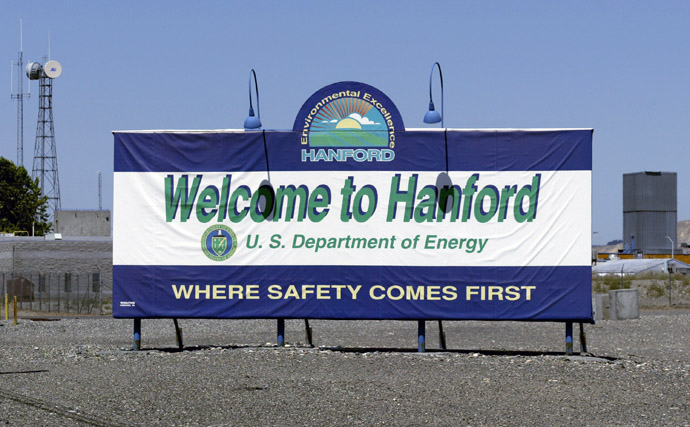
A nuclear production complex operated by the United States federal government on the Columbia River in the U.S. state of Washington. The site has been known by many names, including: Hanford Project, Hanford Works, Hanford Engineer Works or HEW and Hanford Nuclear Reservation or HNR. 

Established in 1943 as part of the Manhattan Project in the town of Hanford in south-central Washington, the site was home to the B Reactor, the first full-scale plutonium production reactor in the world . Plutonium manufactured at the site was used in the first nuclear bomb, tested at the Trinity site, and in Fat Man, the bomb detonated over Nagasaki, Japan. 

Decades of manufacturing left behind 53 million US gallons (200,000 m3) of high-level radioactive waste, an additional 25 million cubic feet (710,000 m3) of solid radioactive waste thats equal to 532 miles of 8 cubic meter cement trucks bumper to bumper , 200 square miles (520 km2) of contaminated groundwater beneath the site . Not to mention the 450 billion gallons dumped into the soil in the 50s and 60s .

A leak in a massive nuclear waste storage tank at the Hanford Site has expanded significantly, KING 5 learned this weekend.
After leak detector alarms sounded early Sunday morning, crews at Hanford lowered a camera into the two-foot-wide space between the tank's inner and outer walls. They discovered 8.4 inches of radioactive and chemically toxic waste has seeped into the annulus.
The U.S. Department of Energy released a statement Monday calling the leak an "anticipated" outcome of an ongoing effort to empty the tank in question. The Washington state Department of Ecology said, "There is no indication of waste leaking into the environment or risk to the public at this time."
But one former tank farm worker said the leak should be considered a major problem.
“This is catastrophic. This is probably the biggest event to ever happen in tank farm history. The double shell tanks were supposed to be the saviors of all saviors (to hold waste safely from people and the environment),” said former Hanford worker Mike Geffre....Read more, see video: http://www.king5.com/news/local/investigations/catastrophic-event-at-hanford-prompts-emergency-response/140990679

http://abcnews.go.com/US/wireStory/massive-nuclear-plant-plan-everglades-delayed-court-38544954

http://toxipedia.org/display/wanmec/Radioactive+contamination+of+the+Columbia+River

Yesterday Tens of Thousands of Gallons of Dissolved Nuclear Rods Leaked Into the Columbia River | Politics:


Support Global Rumblings Sponsors


 Protandim by LifeVantage  - Frank Robinson, LifeVantage

ABCLiveIt News Clip    Protandim Test on Human Volunteer
http://www.abcliveit.com/abc-news-clip.html


Plan for Survival at Home    Click Here!  
Pandemic, Natural Disasters, Etc.

Sunday, June 19, 2011

Airspace Over Flooded Nebraska Nuclear Power Plant Closed

Closing AIR SPACE because of FLOODING?  Strange... 

A fire in Nebraska's Fort Calhoun nuclear power plant briefly knocked out the cooling process for spent nuclear fuel rods, ProPublica reports.
The fire occurred on June 7th, and knocked out cooling for approximately 90 minutes. After 88 hours, the cooling pool would boil dry and highly radioactive materials would be exposed.
fort calhoun power plant

On June 6th, the Federal Administration Aviation (FAA) issued a directive banning aircraft from entering the airspace within a two-mile radius of the plant.
"No pilots may operate an aircraft in the areas covered by this NOTAM," referring to the "notice to airmen," effective immediately.
Since last week, the plant has been under a "notification of unusual event" classification, becausing of the rising Missouri River. That is the lowest level of emergency alert.
The OPPD claims the FAA closed airspace over the plant because of the Missouri River flooding. But the FAA ban specifically lists the Fort Calhoun Nuclear Power Plant as the location for the flight ban.


Read more: http://www.businessinsider.com/faa-closes-airspace-over-flooded-nebraska-nuclear-power-plant-2011-6#ixzz1PljgOMfM


dutchsinse,

6/19/2011 -- Severe lightning -- Saint Louis, Missouri

 :

  • @Montagraph thanks.. hope all is well at your end sir ! hope all that other "stuff" is water under the bridge.. be safe and much love @ you
  • do you ever sleep?
    
  • @wakingup2010 not since I read that nebraska is under nuclear alert and the airspace is closed due to FLOODING !! lol..
    closing airspace due to flooding.. whatever!!.. this is strange... very strange!

Sources:

Airspace Over Flooded Nebraska Nuclear Power Plant Still Closed: "Airspace Over Flooded Nebraska Nuclear Power Plant Still Closed"http://www.businessinsider.com/faa-closes-airspace-over-flooded-nebraska-nuclear-power-plant-2011-6

The Anti-Christ Identity? Can we know it now? Click Here!

FREE SHIPPING on orders $35+ from Fabric.comAlex Jones' Infowars Business Team:
Products: Suzanne Somers, Dr. Joel Wallach and many others.


Roy's GhP Anti-Aging: Regain your Strength at any age.

Search & Win

Tuesday, June 14, 2011

Nebraska Nuclear Plant: Emergency Level 4 - Getting Worse


Electrical Fire Knocks Out Spent Fuel Cooling at Nebraska Nuke Plant


Flooding causes fire, loss of cooling for 90 minutes..


UPDATE:  Situation is worsening

June 14, 2011


l,500,000 people nearby in Omaha, Nebraska


Emergency Alert : Nebraska Nuclear Plant: Emergency Level 4 Getting Worst June 14 2011

Electrical Fire Knocks Out Spent Fuel Cooling at Nebraska Nuke Plant
by John Sullivan
Special to ProPublica June 9, 2011, 11:20 a.m.

A fire in an electrical switch room on Tuesday briefly knocked out cooling for a pool holding spent nuclear fuel at the Fort Calhoun nuclear plant outside Omaha, Neb., plant officials said.


The safety of deep pools used to store used radioactive fuel at nuclear plants has been an issue since the accident at Japan's Fukushima nuclear plant in March. If the cooling water a pool is lost, the used nuclear fuel could catch fire and release radiation.


As ProPublica reported earlier, fire safety is a continuing concern at the country's 104 commercial reactors, as is the volume of spent fuel piling up at plants.


Officials at Fort Calhoun said the situation at their plant came nowhere near to Fukushima's. They said it would have taken 88 hours for the heat produced by the fuel to boil away the cooling water.


Workers restored cooling in about 90 minutes, and plant officials said the temperature in the pool only increased by two degrees.


The fire, reported at 9:30 a.m., led to the loss of electrical power for the system that circulates cooling water through the spent fuel pool, according to a report from the Nuclear Regulatory Commission. A chemical fire suppression system discharged, and the plant's fire brigade cleared smoke from the room and reported that the fire was out at 10:20 a.m., the NRC said.


Mike Jones, a spokesman for the plant's owner, the Omaha Public Power District, said Fort Calhoun has a backup pump to provide water to the spent fuel in case the main system is lost. That pump, which runs on a separate power supply from the rest of the plant, was inspected and standing by on Tuesday, but plant operators restored main power to the pool before the emergency pump was needed, he said.


Fort Calhoun's single reactor has been shut down since April for refueling. The plant had already been operating under a heightened level of alert because of nearby flooding on the Missouri River, the NRC said. The cause of the fire remained under investigation this morning.


Contributing sources:

http://www.liveleak.com/view?i=147_1308093690

http://www.theoilage.com/fort-calhoun-nuclear-plant-missouri-river-flood-t3752.html


The Anti-Christ Identity? Can we know it now? Click Here!

FREE SHIPPING on orders $35+ from Fabric.com


Alex Jones' Infowars Business Team:
Products: Suzanne Somers, Dr. Joel Wallach and many others.


Roy's GhP Anti-Aging: Regain your Strength at any age.

Search & Win

Nebraska Nuclear Plant: Emergency Level 4 - Getting Worse


June 14, 2011


Electrical Fire Knocks Out Spent Fuel Cooling at Nebraska Nuke Plant


Flooding causes fire, loss of cooling for 90 minutes..


 l,500,000 people nearby in Omaha, Nebraska


Emergency Alert : Nebraska Nuclear Plant: Emergency Level 4 Getting Worst June 14 2011  
Electrical Fire Knocks Out Spent Fuel Cooling at Nebraska Nuke Plant
by John Sullivan
Special to ProPublica June 9, 2011, 11:20 a.m.

A fire in an electrical switch room on Tuesday briefly knocked out cooling for a pool holding spent nuclear fuel at the Fort Calhoun nuclear plant outside Omaha, Neb., plant officials said.

The safety of deep pools used to store used radioactive fuel at nuclear plants has been an issue since the accident at Japan's Fukushima nuclear plant in March. If the cooling water a pool is lost, the used nuclear fuel could catch fire and release radiation.

As ProPublica reported earlier, fire safety is a continuing concern at the country's 104 commercial reactors, as is the volume of spent fuel piling up at plants.

Officials at Fort Calhoun said the situation at their plant came nowhere near to Fukushima's. They said it would have taken 88 hours for the heat produced by the fuel to boil away the cooling water.

Workers restored cooling in about 90 minutes, and plant officials said the temperature in the pool only increased by two degrees.

The fire, reported at 9:30 a.m., led to the loss of electrical power for the system that circulates cooling water through the spent fuel pool, according to a report from the Nuclear Regulatory Commission. A chemical fire suppression system discharged, and the plant's fire brigade cleared smoke from the room and reported that the fire was out at 10:20 a.m., the NRC said.

Mike Jones, a spokesman for the plant's owner, the Omaha Public Power District, said Fort Calhoun has a backup pump to provide water to the spent fuel in case the main system is lost. That pump, which runs on a separate power supply from the rest of the plant, was inspected and standing by on Tuesday, but plant operators restored main power to the pool before the emergency pump was needed, he said.

Fort Calhoun's single reactor has been shut down since April for refueling. The plant had already been operating under a heightened level of alert because of nearby flooding on the Missouri River, the NRC said. The cause of the fire remained under investigation this morning.


Contributing sources:

http://www.liveleak.com/view?i=147_1308093690

http://www.theoilage.com/fort-calhoun-nuclear-plant-missouri-river-flood-t3752.html


The Anti-Christ Identity? Can we know it now? Click Here!

FREE SHIPPING on orders $35+ from Fabric.com


Alex Jones' Infowars Business Team:
Products: Suzanne Somers, Dr. Joel Wallach and many others.


Roy's GhP Anti-Aging: Regain your Strength at any age.

Search & Win

Wednesday, March 16, 2011

Japan Nuclear Threat Not a Problem to US


Japanese plant poses little threat to US — for now


Evacuees are screened for radiation contamination at a testing center Tuesday, March 15, 2011, in Koriyama city, Fukushima Prefecture, northern Japan,AP – Evacuees are screened for radiation contamination at a testing center Tuesday, March 15, 2011, in Koriyama …
It's a big ocean between northeastern Japan and the United States and thousands of miles from the crippled nuclear power plant to much of Asia. That means there's little chance — at least for now — that radiation from the shattered reactors could pose a serious threat to the wider world.
Experts say the amount of radioactivity emitted by the facility has been relatively minor and should dissipate quickly over the Pacific Ocean.
"Every mile of ocean it crosses, the more it disperses," said Peter Caracappa, a radiation safety officer and clinical assistant professor of nuclear engineering at Rensselaer Polytechnic Institute in Troy, N.Y.
The only people at immediate risk are workers inside the plant and the people living closest to it. The danger of radiation exposure elsewhere is minuscule — unless the plant sustains a complete meltdown, which would sharply escalate the dangers.
Japanese officials told the International Atomic Energy Agency on Tuesday that a fire had broken out in a fuel storage pond where used nuclear fuel is kept cool and that radiation had been "released directly into the atmosphere."
If the water level in such storage ponds drops to the level of the fuel, a worker standing at the railing looking down on the pool would receive a lethal dose within seconds, according to a study by the Millstone nuclear plant in Connecticut.
Such intense radiation can prevent workers from approaching the reactor or turn their tasks "into suicide missions," said David Lochbaum, a nuclear engineer who heads the nuclear safety program of the Union of Concerned Scientists.
Next in the line of danger would be those who live within a 20-mile radius. Areas around the plant have been evacuated for that reason.
"The odds of someone outside the plant getting an acute injury — sick in the next couple of weeks — is close to zero," said John Moulder, a professor of radiation oncology at the Medical College of Wisconsin in Milwaukee who studies the effects of radiation exposure.
The radioactive particles probably contain materials linked to cancer in high doses, including cesium and iodine. The long-term cancer risk for nearby residents will depend on exposure and cleanup efforts, Moulder said.
Radioactive cesium and iodine also can combine with the salt in sea water to become sodium iodide and cesium chloride, which are common elements that would readily dilute in the wide expanse of the Pacific, according to Steven Reese, director of the Radiation Center at Oregon State.
Winds in the area are currently blowing toward the coast because of a winter storm. But that will change to a brisk wind blowing out to sea at least through Wednesday, he said by telephone.
Still, the forecast offered little comfort to those living in the area — and in nearby countries such as Russia.
The Russian Emergencies Ministry said it was monitoring radiation levels and had recorded no increase.
Many Russians, however, distrust the reassurances, perhaps remembering the Chernobyl disaster 25 years ago and how long it took the Soviet government to reveal the true dangers of the radiation.
"The mass media tells us that the wind is blowing the other way, that radiation poses no threat. But people are a mess," Valentina Chupina, a nanny in Vladivostok, said in a comment posted on the website of the newspaper Delovoi Peterburg. "They don't believe that if something happens we'll be warned."
The news portal Lenta said that in addition to potassium iodide and instruments used to measure radiation, people in the Far East also were stocking up on red wine and seaweed, which they believed would offer protection from radiation.
Even so, many experts here say that this emergency is nowhere near the level of Chernobyl, the worst nuclear disaster in history.
For one, that reactor's core contained graphite that caught fire, which blasted radiation high into the air and into wind currents that carried it long distances. The Japanese core is metal and contains no graphite, experts said.
The Chernobyl plant also lacked a heavy shell around the reactor core. And the incident there happened quickly, with little time to warn nearby residents.
So far, the radiation released in Japan has not reached high altitudes, said Kathryn Higley, director of the Oregon State University Department of Nuclear Engineering and Radiation Health Physics.
"In addition, radioactive material is sticky. It has a static charge," she said, so it will stick to the sides of buildings, and "rain is going to knock it down."
As a precaution, the World Meteorological Organization has activated specialized weather centers to monitor the situation. Those centers, in Beijing, Tokyo and Obninsk, Russia, will track any contaminants.
Meanwhile, the International Atomic Energy Agency said a single reading at one location in the Japanese plant recorded levels of 400 millisieverts, or 40 rems, per hour.
"You start getting radiation sickness at around 100 rems" — nausea and vomiting. Damage to blood cells can show up two to four weeks later, said Dr. Fred Mettler, a University of New Mexico radiologist and adviser to the United Nations on radiation safety. He led an international study of health effects after the Chernobyl disaster.
Levels were much lower at a plant gate, and "if you get further away from that, the population got a very small dose if anything," said Kelly Classic, a radiation physicist at the Mayo Clinic and a representative for the Health Physics Society, an organization of radiation safety specialists.
The U.S. Nuclear Regulatory Commission says doses of less than 100 millisieverts, or 10 rems, over a year are not a health concern.
By comparison, most people receive about three-tenths of a rem every year from natural background radiation, according the U.S. Environmental Protection Agency. A chest X-ray delivers about .1 millisieverts, or .01 rem of radiation; a CT scan of the abdomen and pelvis is about 14 millisieverts, or 1.4 rems.
If a full meltdown occurs at the Japanese plant, the health risks become much greater — with potential release of uranium and plutonium, said Dan Sprau, an environmental health professor and radiation safety expert at East Carolina University in Greenville, N.C.


Life-saving Kelp 


Anti-Aging: Turn the Clock Back!

Search & Win

10 Day Weight Loss Pills

Popular Posts

URGENT - Your LIBERTY at RISK


GET A GROUPON!


Curious about what the future holds? Click here to find out how you can receive a 10 minute psychic reading from Psychic Source.

Calculator-1.com - The Best Free Online Calculatorн

Fine Art - Painting Lessons: Real Art!
What is Bio-Farming? Can anyone do it?
Related Posts Plugin for WordPress, Blogger...

CURRENT MOON
My Zimbio
Top Stories
 
My Zimbio
Top Stories Get 100 FREE Visitors to Your Website!
eXTReMe Tracker
AyurCat for Cat Health Care